Happy Cartoon Font for Playful, Professional Branding
Two weeks ago, I was reworking the product labels for my friend’s small-batch candle studio—hand-poured soy candles with names like “Sunrise Grove” and “Midnight Lavender.” She’d been using a free font that looked cheerful but blurry at small sizes, and her Instagram Stories kept getting comments like “Is that ‘Lavender’ or ‘Laverder’?” That tiny readability hiccup was costing her clarity—and quiet confidence in her own brand. So we swapped it out for Happy Cartoon, and suddenly, everything clicked: the labels popped on jars, the website banner felt cohesive, and even her handwritten-style thank-you cards gained structure without losing warmth. That’s the quiet power of the right display font.
Happy Cartoon for Product Labels and Handmade Packaging
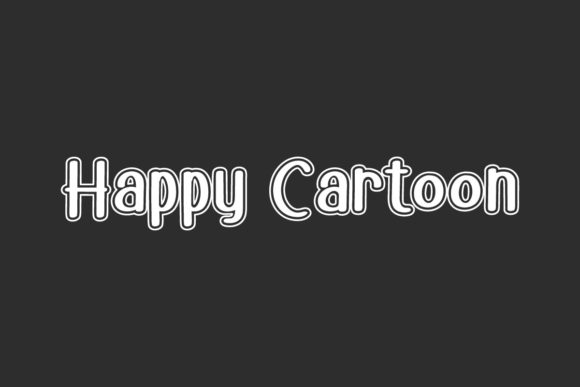
Happy Cartoon is a display font built for visibility and personality—not subtlety. Its rounded, bouncy letterforms have just enough whimsy to feel joyful, but enough precision to read cleanly at 10pt on a 2oz candle label or 14pt on a kraft paper gift tag. Unlike many playful fonts that sacrifice legibility for charm, Happy Cartoon keeps counters open, spacing generous, and x-height friendly—so “Vanilla Cloud” doesn’t blur into “Vanil a Cloud” when printed on matte sticker stock. As a small business owner who orders labels in batches of 50–200, I appreciate that it works straight out of the box: no kerning tweaks needed for common word pairings, no hidden ligatures to accidentally activate. It’s one of those rare fonts that feels handmade but performs like a premium font—especially for food, beauty, and artisan goods where approachability matters as much as polish.
Happy Cartoon for Logo Design and Branding Consistency
If your logo lives on a café apron, an Etsy banner, and the bottom corner of a compostable mailer, consistency isn’t optional—it’s how people recognize you before they even read your name. Happy Cartoon shines here because it holds its shape across scales and surfaces. We tested it in a simple lockup for a neighborhood bakery’s new sourdough loaf bag: “Hearth & Honey” in Happy Cartoon (all caps, medium weight), paired with a clean sans serif for the tagline. On screen, it felt bright and inviting; on uncoated paper, it stayed crisp—not fuzzy, not thin, not overly cartoonish. That balance is why Happy Cartoon works so well as a primary branding font: it’s distinct enough to anchor a visual identity, yet versatile enough to sit beside a modern serif for quotes or a minimalist sans for body text. As a display font, it’s not meant for paragraphs—but it *is* meant to be the first thing people remember about your brand.
Happy Cartoon for Invitations, Cards, and Stationery Design
Whether it’s a wedding invitation suite, a boutique’s seasonal thank-you card, or a coach’s printable affirmation deck, stationery is where tone becomes tactile. Happy Cartoon brings lightness without sacrificing elegance—its curves are smooth, not jagged; its rhythm is bouncy, not chaotic. I used it for a set of floral-themed greeting cards last month: “You’re Amazing” in large Happy Cartoon over soft watercolor blooms, then a delicate serif for the rest. The contrast worked beautifully—Happy Cartoon carried the emotional weight, while the supporting type handled the details. As a display font, it’s ideal for headlines, short phrases, and decorative accents—not long copy—but that’s exactly what makes it perfect for invitations and cards. Bonus: it includes standard OpenType features like stylistic alternates and basic multilingual support, so it handles common European accents gracefully if you’re designing for broader audiences.
Happy Cartoon for Social Media Graphics and Online Shop Banners
Let’s talk thumbnails. On Instagram or Etsy, your banner has ~3 seconds to say, “This is for you.” Happy Cartoon delivers that in under ten letters. Its high-contrast, friendly silhouette reads instantly—even at mobile scale—making it ideal for shop headers, story highlights, or limited-time promo graphics (“Summer Sale!” or “New Arrivals”). As a display font, it pairs effortlessly with clean sans serifs (think Inter, Poppins, or Montserrat) for body text or captions. We used it for a ceramicist’s Instagram template pack: bold Happy Cartoon headlines over neutral photos, with subtle sans-serif subheads. No designer needed—just drag, drop, and go. And because it’s a commercial font licensed for digital use, you can safely embed it in Canva templates, Shopify banners, or PDF lookbooks without worrying about licensing gaps. Just double-check the file formats included (.OTF/.TTF) and confirm multilingual glyphs match your audience’s needs before finalizing.
Happy Cartoon for Headings, Quotes, and Branded Stickers
Stickers sell mood as much as merchandise. A “Good Vibes Only” sticker shouldn’t feel stiff or corporate—and it shouldn’t look like clip art either. Happy Cartoon lands right in that sweet spot: expressive, scalable, and unmistakably human. Its consistent stroke weight and cheerful proportions make it ideal for quote graphics, packaging accents, and branded stickers—whether laser-cut on vinyl or printed on kraft paper. As a display font, it thrives in short bursts: titles, slogans, callouts. For longer text, pair it thoughtfully—a warm script for signatures, a grounded sans for descriptions. And yes, it works on dark backgrounds too (just avoid ultra-thin weights for small print). If your brand voice leans kind, creative, or quietly joyful—and you want typography that reflects that without shouting—it’s worth trying Happy Cartoon. Not as a gimmick, but as a thoughtful, working part of your brand identity.