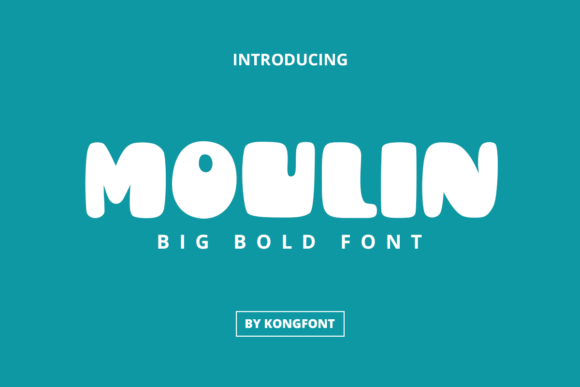
Moulin Display Font for Handmade Brands
As a crafter who designs printable wall art, wedding stationery, and custom product labels for my Etsy shop, I need fonts that look handmade but hold up in production — and Moulin is the display font that finally bridges that gap. It’s bold, warm, and intentionally chunky — not stiff or overly digital — so it feels like it belongs on a hand-stamped tote bag, a rustic wedding welcome sign, or a soy candle label you’d see at a local boutique. As a display font, Moulin isn’t meant for paragraphs — it shines where attention matters: names, titles, short phrases, and branded moments that customers remember.
Moulin for Wedding Invitations and Elegant Branding
When I designed my first full wedding suite for a client last spring, I tested over a dozen display fonts before landing on Moulin. Its generous letterforms and balanced weight make it instantly legible at 36pt on matte cardstock — no blurry edges, no awkward gaps between letters when printed or cut. I used Moulin for the couple’s names on the invitation front, paired with a soft serif for body text, and added subtle flourishes to the “&” glyph (Moulin includes stylistic alternates). For the welcome sign, I scaled it up to 120pt in Cricut Design Space — and it cut cleanly on birch plywood with zero chipping. Because Moulin is built for clarity at scale, it works equally well on delicate vellum inserts and thick acrylic table numbers. If you’re selling wedding printables or offering custom stationery as a service, this display font delivers elegance without sacrificing commercial usability.
Moulin for Product Packaging and Craft Labeling
I use Moulin on every physical product I ship — from lavender soap bars to ceramic mug decals — because it reads beautifully at small sizes *and* holds its character when enlarged. On 1.5-inch sticker labels, the uppercase “A,” “R,” and “O” retain their friendly geometry; on 4-inch kraft tags, the chunky strokes give handmade goods an instant premium feel. As a display font, Moulin avoids the thinness that fades on matte finishes or the exaggerated contrast that breaks down in vinyl cutting. Bonus: it pairs naturally with clean sans serifs (like Montserrat or Poppins) for ingredient lists or care instructions — keeping your branding cohesive across labels, boxes, and social media banners. Since Moulin is licensed for commercial use, I confidently include it in my SVG bundles and printable packaging templates sold on Etsy and Creative Market.
Moulin for Social Media Graphics and Digital Printables
If you create Canva templates, Instagram story kits, or planner pages, you know how quickly a generic font flattens your brand voice. Moulin adds grounded warmth — think “hand-lettered but production-ready.” I use it for quote graphics (“Bloom Where You’re Planted”), monthly headers in undated planners, and seasonal promo banners (hello, “Pumpkin Spice & Everything Nice” fall collection). Because it’s a display font with strong visual rhythm, it scales flawlessly across devices: sharp on mobile previews, rich in PDF downloads, and crisp when exported as PNGs for Pinterest pins. No pixelation. No awkward kerning fixes needed. And since Moulin supports standard Latin characters and common punctuation, it works for English-language printables, greeting cards, and digital stickers without missing glyphs.
Moulin for Craft Signs, Wall Art, and Seasonal Decor
My farmhouse-style “Gather” sign — cut from ⅛-inch baltic birch and painted white — wouldn’t have the same inviting presence without Moulin. The font’s sturdy counters and open apertures prevent fill-in during paint application, and its consistent stroke weight means no letter looks heavier or lighter than the rest. I’ve used it for Easter egg hunt signs, Christmas ornament tags, and even chalkboard-style menu boards for pop-up markets — always converting to outlines first in Illustrator to preserve integrity. As a display font, Moulin doesn’t compete with imagery; it complements texture, wood grain, and hand-drawn elements. Whether you’re designing SVG files for Silhouette users or printable holiday art for teachers, this font gives your work instant craft credibility.
Moulin Font Pairing Ideas for Handmade Sellers
You don’t need ten fonts to build a strong brand — just two that work *together*. With Moulin, I lean into contrast: pairing its bold presence with something quiet and functional. For wedding suites, I combine Moulin (for names and headings) with a gentle serif like Playfair Display (for ceremony details). For product labels, I pair it with Lato or Open Sans — clean, legible, and free for commercial use. If you’re creating digital downloads, try Moulin + a relaxed script font for accents (like “Handwritten Love” or “Sofia Script”) — just keep scripts minimal and reserved for single words so readability stays high. Remember: Moulin is a display font, so let it lead — then support it with typefaces that recede gracefully.
Moulin Fonts for Commercial Use and Physical Product Sales
This matters: Moulin comes with a commercial license that covers physical goods, digital templates, SVG files, client work, and resale of printables — no extra fees, no hidden limits. That means if you sell candle labels on Etsy, design Canva templates for small businesses, or create Cricut-ready SVG bundles, you’re fully covered. I’ve embedded Moulin in editable PDFs, included it in layered PSD mockups, and used it across Shopify banners and Instagram ads — all without licensing concerns. As a display font, it’s optimized for impact, not volume — so it’s perfect for crafters who value quality over quantity in their design assets. When your font carries your brand’s tone *and* your legal peace of mind, it stops being just typography — it becomes part of your shop’s foundation.